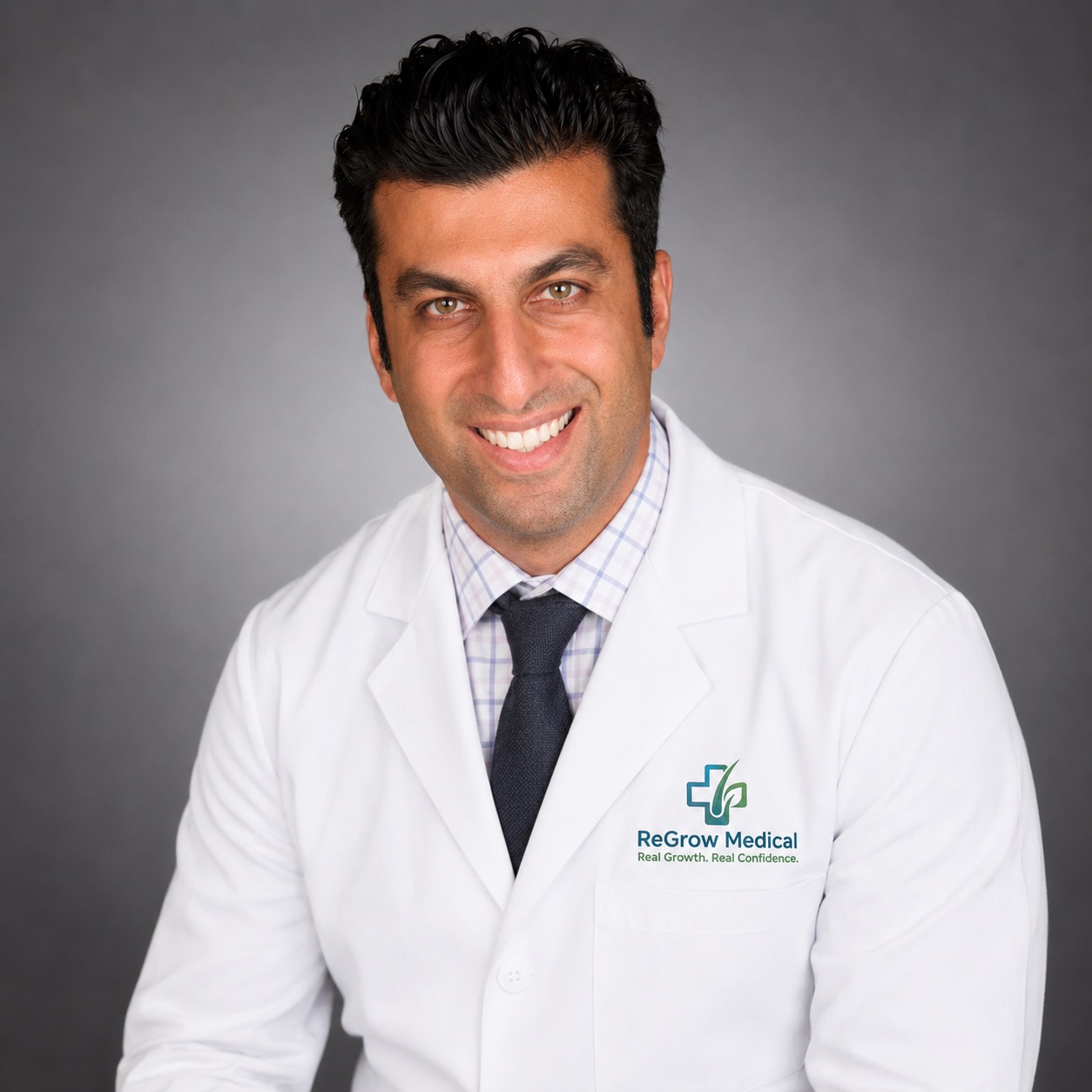
Dr. Amiel Moshfegh, M.D.
Founder and Medical Director, ReGrow Medical · Hair-restoration physician · Vascular and interventional radiologist
Dr. Moshfegh is the founder and medical director of ReGrow Medical and president of Southern California Vascular Institute. He brings more than a decade of hair-restoration study and practice alongside more than 16 years performing minimally invasive procedures.
Credentials at a Glance
- M.D.: New York Medical College
- Hair restoration: More than a decade of study and practice
- Minimally invasive care: More than 16 years of experience
- Clinical team: More than 20 years of combined hair-restoration experience
- ReGrow Medical: Founder and medical director
- Southern California Vascular Institute: President
About Dr. Moshfegh
A Southern California native, Dr. Moshfegh began his medical education at UC Berkeley, where he graduated with honors with a bachelor's degree in molecular and cellular biology. He earned his Doctor of Medicine degree from New York Medical College.
His postgraduate training included an internship and radiology residency at the UCLA Kaiser Permanente Center, a mini-fellowship in interventional radiology, and fellowship training in vascular and interventional radiology at Cornell–NewYork-Presbyterian Hospital and Memorial Sloan Kettering Cancer Center.
Dr. Moshfegh later founded ReGrow Medical to focus on individualized hair-restoration care, applying principles of careful tissue handling, instrument control, and patient-specific planning from his minimally invasive procedural background.
Experience applied to hair restoration
How His Minimally Invasive Background Informs His FUE Approach
More than 16 years performing minimally invasive procedures have shaped Dr. Moshfegh's approach to tissue handling, instrumentation, and precise, controlled movements. He applies those principles to FUE hair transplantation: carefully harvesting individual follicular units, handling grafts thoughtfully, and planning around the donor tissue that remains.
Careful tissue handling
His approach emphasizes controlled movements and gentle graft handling to limit unnecessary tissue trauma. The aim is to protect each follicular unit through harvesting, preparation, and placement.
Individual instrument selection
Hair characteristics and scalp anatomy guide the selection of appropriately sized instruments. At ReGrow Medical, handheld micro-punch instruments typically measure 0.7–0.9 mm; the choice is tailored to the case rather than assuming the smallest punch is always best.
Real-time adjustment
Direct visualization and hands-on instrument control allow the technique to be adjusted as hair direction and tissue characteristics change. Dr. Moshfegh values that flexibility when developing and guiding the surgical plan.
Long-term donor planning
He considers the distribution of existing hair, donor availability, and possible future loss—not just the number of grafts moved in one session. Preserving the remaining donor area is part of planning for the patient's long-term goals.
Why He Chooses a Physician-Guided, Hands-On Approach
Dr. Moshfegh has hands-on experience with robotic-assisted hair-restoration technologies and has spent years evaluating different FUE approaches. For his practice at ReGrow Medical, he favors handheld instrument control and the ability to adjust technique to each patient's follicles and anatomy.
That preference is about how he works, not a claim that every robotic system is less precise. Manual, handheld motorized, and robotic-assisted FUE are different tools for a physician-led procedure. Patient selection, instrument use, graft handling, and the treatment plan all matter; the device alone does not determine the result.
A Trained Team, Working From One Clinical Plan
ReGrow Medical's team brings more than 20 years of combined hair-restoration experience. This is a combined team figure, separate from Dr. Moshfegh's own experience. He has developed an internal training curriculum based on the techniques and principles he has refined through study and clinical practice.
Training emphasizes careful graft handling, strategic harvesting, donor-area preservation, and placement guided by the intended hair direction and design. Team members work within their respective roles and qualifications, following the physician-led plan rather than treating each stage as a separate task.
The procedure should be designed around the patient—not around the technology.
His goal is personalized, natural-looking hair restoration that respects each patient's donor supply, existing hair, and long-term priorities. The appropriate plan and expected results depend on an individual assessment.
Understand the FUE process · Compare physician-guided and robotic FUE
More Than a Decade of Hair-Restoration Study and Practice
Dr. Moshfegh's work in hair restoration includes FUE scalp hair transplantation, hairline planning, donor-area assessment, and eyebrow and beard restoration. An individual evaluation is used to determine what is medically appropriate and realistically achievable rather than fitting every patient into the same graft number or procedure.
What a Hair-Restoration Evaluation Considers
- Hair-loss pattern: The pattern, timing, medical history, and whether another type of evaluation is needed.
- Donor area: Donor density, hair characteristics, scalp health, and preservation for possible future loss.
- Priorities: Hairline position, coverage, density, graft distribution, and long-term goals.
- Individual candidacy: A photograph or online estimate cannot confirm candidacy or a surgical plan.
Hair-Restoration Areas
FUE Scalp Hair Transplantation
Individualized planning for selected areas of scalp thinning, including hairline, frontal scalp, mid-scalp, and crown concerns. Explore FUE hair transplantation.
Hair Restoration for Women
Evaluation that accounts for the pattern and cause of thinning, donor-area stability, and the goals that are specific to each patient. Explore hair restoration for women.
Eyebrow Transplantation
Planning for brow shape, follicle selection, placement direction, donor characteristics, and ongoing grooming expectations. Explore eyebrow transplantation.
Beard Transplantation
Facial-hair planning that considers the intended shape, natural growth direction, donor supply, density goals, and facial proportions. Explore beard transplantation.
Clinical Leadership
Dr. Moshfegh serves as president of Southern California Vascular Institute. Over the course of his career, he has also held director-level roles in endovascular intervention at Beverly Hills Vascular Center, VAC of South LA, and Marina Del Rey Hospital.
Medical Review Responsibilities
As medical director, Dr. Moshfegh provides medical review for ReGrow Medical's educational content. Review focuses on clinical accuracy, appropriate context, balanced discussion of benefits and risks, and whether medical statements are supported by cited sources. Editorial authorship is credited separately to the ReGrow Medical Editorial Team. Read our editorial and medical review policy.
Professional Profile and Credential Verification
Credentials and professional roles can change. Use primary registries for current verification and the professional biography for education and training history.
- Medical Board of California license verification
- National Provider Identifier: 1144539644
- Southern California Vascular Institute biography
Frequently Asked Questions
Is Amiel Moshfegh a medical doctor?
Yes. Amiel Moshfegh, M.D., earned his medical degree from New York Medical College after completing an undergraduate degree in molecular and cellular biology with honors at UC Berkeley.
How long has Dr. Moshfegh worked in hair transplantation?
Dr. Moshfegh has more than a decade of hair-restoration study and practice, alongside more than 16 years performing minimally invasive procedures. These are distinct areas of experience; the ReGrow Medical team's more than 20 years of combined hair-restoration experience is a separate team total.
How does his vascular and minimally invasive background inform FUE care?
Dr. Moshfegh applies principles of careful tissue handling, instrument control, and patient-specific planning to FUE hair restoration. His approach emphasizes thoughtful graft handling, adjustments for individual follicles and scalp anatomy, and preservation of the remaining donor area.
Why does Dr. Moshfegh prefer handheld FUE instruments?
After hands-on experience with robotic-assisted technologies and evaluation of different FUE approaches, Dr. Moshfegh favors handheld instrument control for his practice. He values the flexibility to select instruments and adjust technique to the patient. This preference is not a claim that handheld FUE is universally superior; outcomes depend on the patient, treatment plan, and how the procedure is performed.
What is Dr. Moshfegh's role at ReGrow Medical?
Dr. Moshfegh is the founder and medical director of ReGrow Medical. He also provides medical review for ReGrow Medical's patient-education content.
What medical training has Dr. Moshfegh completed?
After earning his M.D., Dr. Moshfegh completed an internship and radiology residency at the UCLA Kaiser Permanente Center, including a mini-fellowship in interventional radiology. He later completed fellowship training in vascular and interventional radiology at Cornell–NewYork-Presbyterian Hospital and Memorial Sloan Kettering Cancer Center.
What areas of hair restoration are included in Dr. Moshfegh's profile?
His profile includes FUE scalp hair transplantation, hairline planning, donor-area assessment, and eyebrow and beard restoration. An individual evaluation is needed to determine whether a procedure is appropriate.
Who performs an FUE hair transplant at ReGrow Medical?
Dr. Moshfegh leads the treatment plan, assesses the donor area, designs the hairline, and directly supervises FUE harvesting and recipient-site creation while working alongside the clinical team. Team members assist within their roles and qualifications, including graft preparation, hydration, counting, and placement support. The procedure is not delegated to technicians alone.
Who performs FUE harvesting at ReGrow Medical?
Dr. Moshfegh leads and directly supervises FUE harvesting while working alongside the clinical team. Team members assist within their respective roles and qualifications, following the physician-led donor plan.
How is recipient-site creation handled at ReGrow Medical?
Dr. Moshfegh leads and directly supervises recipient-site creation while working alongside the clinical team. The physician-led design guides the planned angle, direction, and distribution of the transplanted hair, and team members assist within their respective roles and qualifications.
What does the clinical team do during the procedure?
The clinical team supports graft preparation, hydration, counting, and placement according to the physician-led treatment plan and within each team member's role and qualifications.
How long does ReGrow Medical provide postoperative care?
ReGrow Medical provides one year of postoperative care. The timing and format of follow-up are tailored to the patient and procedure, and follow-up does not guarantee a particular result.
Where can I request a consultation?
ReGrow Medical serves patients through six Southern California locations. Contact the scheduling team to request a consultation and confirm Dr. Moshfegh's current availability by location.
Request a Hair-Restoration Consultation
ReGrow Medical serves patients at six Southern California locations. Contact the scheduling team to request a consultation and confirm Dr. Moshfegh's current availability by location. Request a consultation or view all locations.
This profile provides professional background and general information. It does not establish an individual diagnosis, candidacy determination, treatment recommendation, or expected result.