Hairline or Crown First? Planning a Hair Transplant
Written by ReGrow Medical Editorial Team.
Medically reviewed by Dr. Amiel Moshfegh, M.D.
Published . Updated .
Short answer: There is no universal rule that every hair transplant should restore the hairline or crown first. Many plans prioritize the frontal hairline because it frames the face and is visible from most angles, while a large crown can require substantial donor resources and careful recreation of its whorl. The right sequence depends on the diagnosis, pattern and pace of loss, donor reserve, existing hair, visual goals, and whether a staged plan would protect future options.
A hair transplant moves follicular units from a donor area—usually the back and sides of the scalp—to selected recipient areas. It does not create new follicles. When both the front and crown are thinning, planning is therefore an allocation decision: where can a limited supply of donor hair create the most useful and sustainable improvement?
This article provides general education, not a diagnosis, graft estimate, or surgical recommendation. A final plan requires an individualized medical history and examination of the scalp, donor area, and recipient areas.
Hairline vs. Crown: A Quick Planning Guide
| Your situation | Planning consideration | Question to discuss |
|---|---|---|
| Frontal recession with little crown loss | The frontal third may provide the clearest visual framing benefit. | How will the hairline still look if recession progresses behind it? |
| Isolated, established crown thinning | Crown-first treatment may fit the patient's main concern when the diagnosis, donor supply, and future pattern support it. | How large is the true thinning area, and how will the whorl be recreated? |
| Hairline and crown loss with limited donor reserve | Full density across both zones may be unrealistic; priority, lighter coverage, or staging may be discussed. | Which area creates the greatest benefit while preserving future options? |
| Rapidly changing or unclear hair loss | Diagnosis and stability come before cosmetic allocation. | Should surgery wait while the cause and likely progression are evaluated? |
| Advanced loss with adequate donor characteristics | A combined or staged front-to-back plan may be possible, but coverage and density still require tradeoffs. | What will remain in reserve after the proposed plan? |
Bottom line: “Hairline or crown first?” cannot be answered by age, a Norwood-Hamilton stage, an online photograph, or a target graft number alone. It is a long-term design question.
What Counts as the Hairline, Mid-Scalp, and Crown?
The frontal hairline forms the leading edge of the hair and helps frame the face. Behind it, the frontal scalp and mid-scalp create the visual bridge toward the back. The crown, also called the vertex, is the rounded area around the natural hair whorl.
These areas do not behave like three identical boxes. A hairline depends on fine irregularity, suitable height, and carefully controlled direction and angle. The crown curves away from the viewer and contains a spiral pattern. The mid-scalp affects how coverage transitions between them. A plan should consider how the zones work together rather than treating each one as an isolated patch.
Why Donor Hair Is the Limiting Resource
A graft is a naturally occurring follicular unit and may contain one or more hairs. With follicular unit excision (FUE), selected follicular units are removed from the donor area and moved to recipient sites. The extracted follicles do not regenerate at those extraction points, so responsible spacing and long-term donor management matter.
Available donor supply differs substantially between patients. Evaluation may consider density, miniaturization, hair-shaft caliber, curl or wave, hair-to-scalp color contrast, scalp condition, previous procedures, preferred haircut, and the likely boundaries of a stable donor zone. Our guide to what happens to the donor area after FUE explains why removal must be planned rather than treated as an unlimited source.
The goal is not to remove the largest possible number in one session. It is to use an appropriate amount in a pattern that can remain coherent if native hair continues to thin.
Why the Hairline Is Often Prioritized
The frontal hairline is visible during face-to-face interaction and influences the apparent proportions of the face. Restoring the frontal third can also improve how hair is styled from the front and sides. For those reasons, clinicians may recommend allocating limited donor hair to the hairline and frontal scalp before attempting complete crown coverage.
That is a planning tendency—not a universal rule. The lowest or densest possible hairline is not automatically the best design. A very low hairline can consume donor resources and may become difficult to support if surrounding native hair recedes. Height, shape, temporal recession, transition density, facial proportions, current pattern, and possible future loss should be considered together.
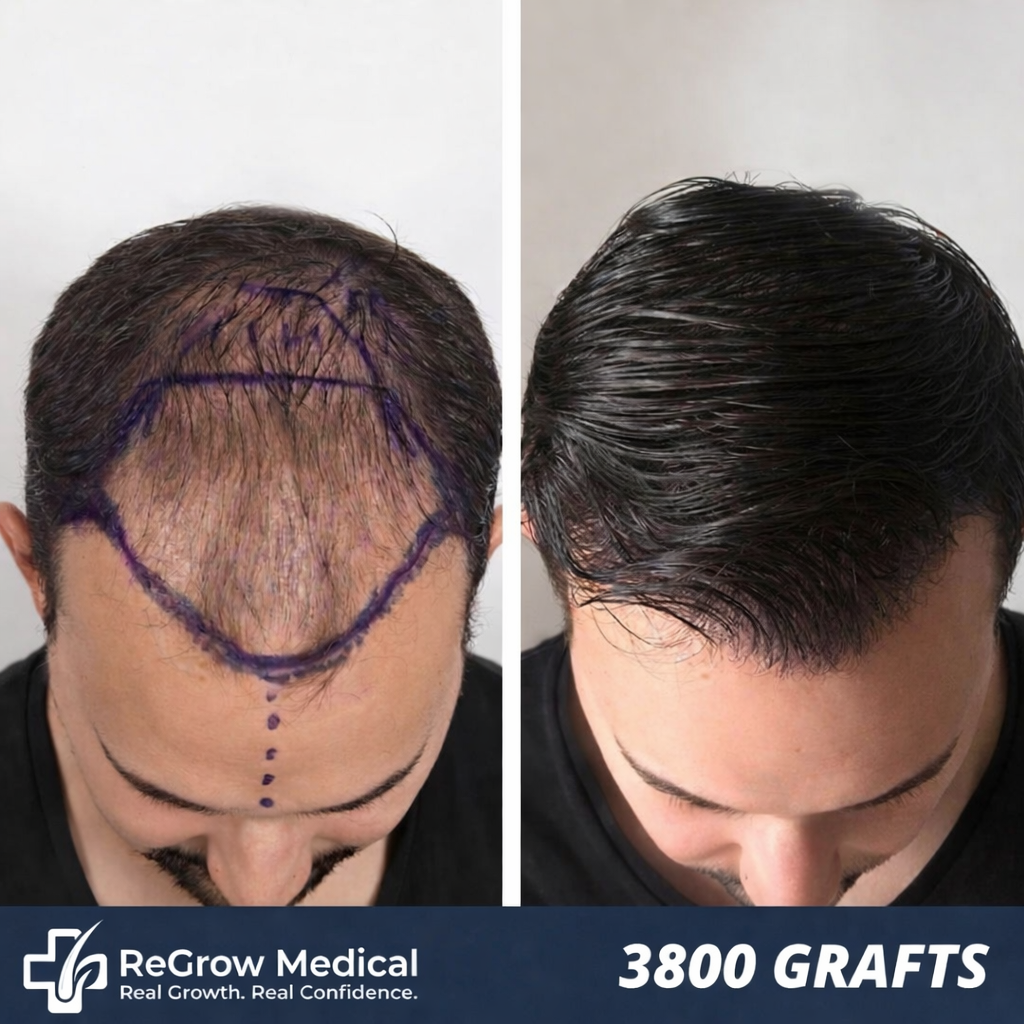
When Crown-First Treatment May Be Reasonable
Crown-first treatment may be considered when the crown is the patient's main concern, frontal hair remains acceptable, the diagnosis and likely pattern are sufficiently understood, and donor characteristics support the proposed coverage. A patient with isolated vertex thinning may value crown coverage more than a small change at the front.
The patient's priorities should be taken seriously. The International Society of Hair Restoration Surgery notes that donor and recipient areas should be outlined in relation to the patient's goals before FUE. At the same time, a responsible recommendation must explain how the selected area affects the remaining donor reserve and future choices.
Why the Crown Can Be Demanding to Restore
The crown is a curved, three-dimensional surface with hairs rotating around one or more whorl centers. Recipient sites must follow an appropriate direction and angle so that growth does not appear to radiate unnaturally. The apparent size of crown thinning can also change with lighting, hair length, styling, and continued miniaturization around the visible center.
A broad crown may require substantial donor resources to create useful visual coverage. That does not mean the crown always needs more grafts than the hairline; area size, existing hair, hair characteristics, target coverage, and design vary. It means a crown quote should be explained rather than presented as a universal package.
Can the Hairline and Crown Be Restored Together?
Possibly. Some patients may be suitable for a combined plan, while others may benefit from concentrating grafts in one priority zone or dividing treatment into stages. The decision depends on how much can be harvested responsibly, the size of each recipient area, existing native density, surgical history, medical factors, and the desired balance between coverage and density.
A combined session should not be sold simply because both areas are visible. Ask how many follicular units are intended for the hairline, mid-scalp, and crown; what visual goal is expected in each zone; and how much donor reserve is expected to remain. For context, read how clinicians develop an individualized hair-transplant graft estimate.
When a Staged Plan Can Make Sense
Staging can allow the most important area to be addressed first and the next decision to be made after healing, growth, and any change in native hair are reassessed. One plan might establish a conservative frontal frame and mid-scalp transition before revisiting the crown. Another might address a well-defined crown concern while preserving options for the front.
There is no universal interval or sequence that suits every patient. Timing should be individualized, and a second procedure should not be treated as automatic. The value of staging is flexibility: it can reduce the pressure to solve every visible area in a single operation.
What a Proper Evaluation Should Measure
- Working diagnosis: A transplant should not be planned as a substitute for diagnosing sudden, patchy, painful, inflamed, scarring, or otherwise unexplained loss.
- Pattern and progression: The design should account for what may happen to native hair around and between transplanted areas.
- Donor characteristics: Density, miniaturization, caliber, texture, contrast, scalp health, scarring, and previous extraction affect what can be moved responsibly.
- Recipient-area dimensions: The true frontal, mid-scalp, and crown areas should be mapped rather than estimated from one photograph.
- Coverage priorities: The patient and clinician should agree on which change matters most and what tradeoffs accompany it.
- Long-term reserve: The plan should explain what may remain available if loss progresses or revision is needed.
- Expectations: No plan can guarantee a particular density, graft-survival percentage, invisible scarring, or exact cosmetic result.
The American Academy of Dermatology explains that candidacy can depend on the ability to grow hair in the donor area and the condition of the recipient scalp. A proper evaluation may therefore reach several reasonable conclusions: proceed, change the priority, reduce the intended area, stage treatment, seek dermatology evaluation, use a nonsurgical approach, or wait.
Three Hypothetical Planning Scenarios
Scenario 1: Frontal recession plus a small crown spot. If donor reserve is limited and the frontal change is the main concern, a clinician may discuss prioritizing a conservative hairline and frontal transition while monitoring or lightly treating the crown. This is an example, not a recommendation for every similar-looking pattern.
Scenario 2: Stable frontal hair with a widening crown. When the crown is clearly the dominant concern and the surrounding pattern and donor area support treatment, crown-first planning may be reasonable. The whorl direction, present miniaturized hair, expected progression, and remaining reserve still matter.
Scenario 3: Advanced loss across the front, middle, and crown. Trying to reproduce dense coverage everywhere may exceed the available supply. The discussion may focus on a frontal frame, strategic mid-scalp coverage, lighter crown coverage, or a staged plan. Honest limits are part of good planning.
Questions to Ask Before Choosing the Hairline or Crown
- What is the working diagnosis, and is further medical evaluation needed?
- Which area would create the greatest visual benefit for my goals?
- How large are the frontal, mid-scalp, and crown recipient areas?
- How was my donor reserve evaluated?
- How could the plan look if native hair continues to thin?
- How many follicular units are intended for each zone, and why?
- Would one priority area, combined treatment, or staging be more sustainable?
- What coverage and density limitations should I expect?
- Who designs the hairline and crown whorl and creates the recipient sites?
- What donor reserve is expected to remain after the proposed procedure?
A useful consultation should answer these questions in plain language. ReGrow Medical evaluates the hair-loss pattern, donor and recipient areas, goals, and long-term strategy before recommending whether FUE is appropriate. To discuss an individualized plan, request a complimentary consultation at one of our Southern California locations.
Frequently Asked Questions
Should a hair transplant restore the hairline or crown first?
There is no universal order. The hairline is often prioritized because it frames the face and is visible from more angles, but crown-first treatment may be reasonable when the crown is the main, well-defined concern and donor supply supports it. The decision should account for diagnosis, progression, recipient-area size, donor reserve, and personal goals.
Does the crown need more grafts than the hairline?
Not always. A broad crown can require substantial donor resources because of its area and whorl pattern, but the actual requirement depends on existing hair, target coverage, hair characteristics, and the size and design of both zones. Universal graft numbers cannot replace an examination.
Can the hairline and crown be transplanted in one session?
Some patients may be suitable for combined treatment, while others may achieve a more sustainable result by prioritizing one area or staging treatment. A clinician should explain the allocation to each zone, expected coverage, procedure limits, and remaining donor reserve.
Why can the crown look thinner under bright light?
The crown is curved and its hairs rotate around a whorl, which can expose more scalp from certain angles. Hair caliber, color contrast, length, styling, existing miniaturization, and lighting also affect apparent coverage. A photograph under one light source cannot determine graft needs.
What happens if native hair keeps thinning after a transplant?
Transplanted follicles do not prevent untreated native hair from thinning. Continued loss can create new gaps or change the balance between the front, mid-scalp, and crown. Long-term planning should anticipate this possibility and preserve options rather than relying only on today's pattern.
How is donor reserve calculated?
There is no single online formula. Assessment may include the likely stable donor boundaries, density, miniaturization, hair caliber and texture, scalp condition, prior procedures, extraction pattern, haircut preference, and anticipated future needs. The result is an individualized estimate, not a guaranteed lifetime number.
Is crown transplantation appropriate for a younger patient?
Age alone does not decide candidacy. A rapidly changing or uncertain pattern, extensive future-loss risk, limited donor supply, or unrealistic coverage goals may support waiting or a more conservative plan. Diagnosis, progression, donor characteristics, and long-term design matter more than a birthday alone.
Can medication change whether the hairline or crown is treated first?
Medical treatment may be relevant to native-hair preservation for some patients, but appropriateness, risks, contraindications, and expected benefit require discussion with a licensed clinician. Do not start, stop, or change prescription treatment based on an online article.
The Bottom Line
The best plan is not automatically “hairline first,” “crown first,” or “the most grafts possible.” It is the plan that creates a meaningful visual improvement, respects the finite donor supply, remains coherent if native hair changes, and matches the patient's priorities without promising more than surgery can deliver.
If you are deciding between frontal and crown restoration, request a complimentary consultation with ReGrow Medical to review the pattern, donor area, possible priorities, and realistic tradeoffs.
Medical References
Sources last reviewed .
- Hair Transplantation — NCBI Bookshelf (StatPearls)
- Hair Transplant Practice Guidelines — Journal of Cutaneous and Aesthetic Surgery (PubMed Central)
- A hair transplant can give you permanent, natural-looking results — American Academy of Dermatology
- Follicular Unit Extraction Hair Transplant — Journal of Cutaneous and Aesthetic Surgery (PubMed Central)
- Recipient Area — Indian Journal of Plastic Surgery (PubMed Central)
- Trichoscopy for the Hair Transplant Surgeon—Assessing for Mimickers of Androgenetic Alopecia and Preoperative Evaluation of Donor Site Area — Indian Journal of Plastic Surgery (PubMed Central)
- Predicting the Permanent Safe Donor Area for Hair Transplantation in Koreans with Male Pattern Baldness according to the Position of the Parietal Whorl — Archives of Plastic Surgery (PubMed Central)
- FUE Hair Transplant: Benefits, Process & Recovery — International Society of Hair Restoration Surgery
This article is for general education and is not a substitute for an individualized diagnosis or treatment plan. Results and candidacy vary.