Hair Restoration in Bakersfield
ReGrow Medical's Bakersfield location gives people in Bakersfield and Kern County a local place to begin a careful hair-restoration evaluation. The useful question is not simply how many grafts can be placed. It is what is causing the loss, whether it is stable, how much donor hair can be used responsibly, which treatment areas matter most, and whether FUE is appropriate at all.
Bakersfield patients should be able to learn whether they need a transplant, a nonsurgical plan, or more diagnostic evaluation before they commit to treatment. A website, photograph, or calculator can organize questions, but it cannot replace an individualized examination of the scalp and donor area.
Visit ReGrow Medical on San Dimas Street
ReGrow Medical — Bakersfield3941 San Dimas St, Suite 102
Bakersfield, CA 93301
(877) 573-4769
The location is in the medical-office area near Bakersfield Memorial Hospital. Current hours conflict across ReGrow Medical's public listings, so call to confirm appointment time, visit type, and arrival instructions before traveling. Do not rely on an unconfirmed parking or access claim.
Get directions to the Bakersfield location.
Hair Restoration Is Not One Treatment
Bakersfield search results often place surgery, regenerative treatments, and cosmetic camouflage under the same “hair restoration” label. They are different categories, and the appropriate starting point depends on the cause of loss, scalp health, donor supply, and the patient's goal.
FUE hair transplantation
FUE redistributes existing follicular units from a suitable donor area into planned recipient sites. It cannot create an unlimited donor supply or prevent untreated native hair from continuing to thin.
Nonsurgical hair-loss care
Medication or regenerative treatment may aim to preserve or support existing hair when clinically appropriate. It does not perform the same job as a transplant, and the cause of loss should be understood before a treatment is chosen.
Scalp micropigmentation
Scalp micropigmentation can change the visual contrast between hair and scalp, but it does not transplant or regrow hair follicles. A useful consultation should explain which category is being proposed and why.
What Happens at a Bakersfield Hair Restoration Visit?
- Identify the pattern. Discuss when the loss began, how it has progressed, relevant health and family history, prior treatments, and the areas that matter most. Sudden shedding, patchy loss, pain, itching, inflammation, scaling, or scarring can change the next step.
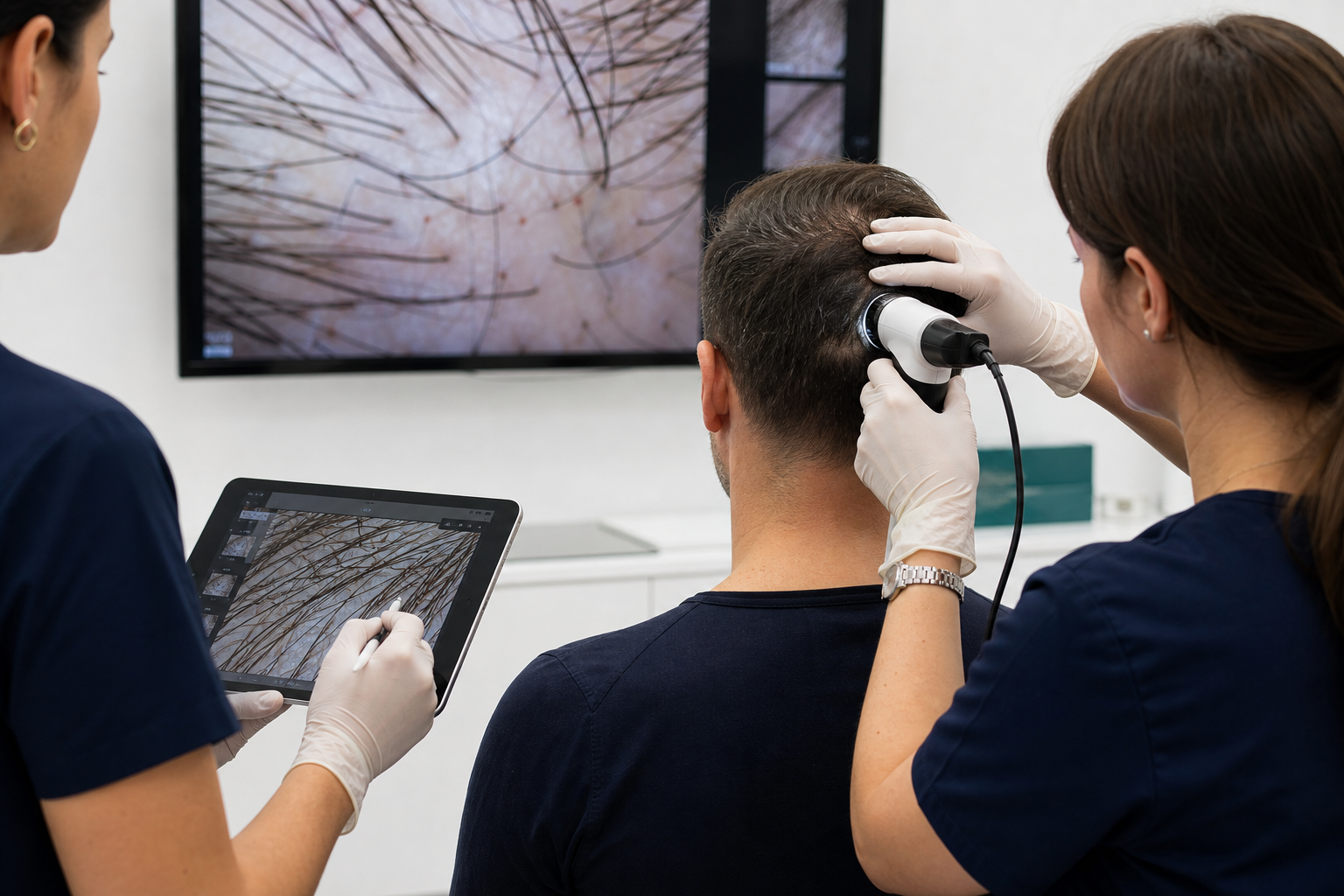
- Examine the donor area. FUE planning looks beyond the thin area. Donor density, caliber, curl, contrast, previous harvesting, scalp health, miniaturization, and the boundaries of the usable donor zone influence what may be possible.
- Set coverage priorities. Hairline, frontal scalp, mid-scalp, and crown work use a finite donor supply differently. The plan should explain where grafts may provide the strongest visual benefit and what reserve may remain.
- Build a practical plan. If FUE appears appropriate, ask about the preliminary graft range, who performs each surgical step, risks, alternatives, recovery, complete cost, and follow-up.
Get a Preliminary Graft Range Before Your Bakersfield Visit
ReGrow Medical's educational simulator lets you select the hairline, temples, frontal area, mid-scalp, crown, or a combination; describe the pattern and progression; answer questions about the donor area; and optionally add clear photographs. It returns a preliminary graft range capped at 3,995 grafts and a basic FUE candidacy screen.
Estimate your preliminary graft range or request a Bakersfield consultation.
Important: Photos are not automatically diagnosed by AI. The result is educational and is not a diagnosis, confirmation of candidacy, treatment recommendation, or surgical plan. Donor density, scalp health, hair characteristics, medical history, and future-loss risk require examination.
How FUE Hair Transplantation Works
Follicular unit excision removes naturally occurring follicular units individually from a suitable donor area and places them into planned recipient sites. Unlike FUT strip surgery, FUE does not remove a strip of scalp and therefore does not create a linear donor scar. It does create many small extraction sites, and tiny scars are possible.
The same graft number can be distributed in very different ways. A frontal frame may create a stronger visual effect than spreading grafts thinly across the front, mid-scalp, and crown. A plan should explain this tradeoff instead of presenting the largest number as automatically better. Read the complete FUE guide and the guide to how graft needs are estimated.
Transplanted hairs commonly shed during the early recovery period before growth develops over subsequent months. FUE does not stop untreated native hair from progressing. Individual healing, growth, density, and cosmetic results vary.
Who May Be a Candidate for FUE?
A possible candidate generally needs a sufficiently understood and stable pattern of loss, a healthy scalp, usable donor hair, goals that fit the finite donor reserve, realistic expectations, and medical suitability for an elective procedure.
Sudden, painful, inflamed, patchy, scarring, rapidly progressing, medically unexplained, or donor-area loss may need additional evaluation before surgery is considered. Recommending observation, nonsurgical care, diagnostic testing, or referral can be the responsible result of a consultation.
Hairline, Mid-Scalp, and Crown Planning
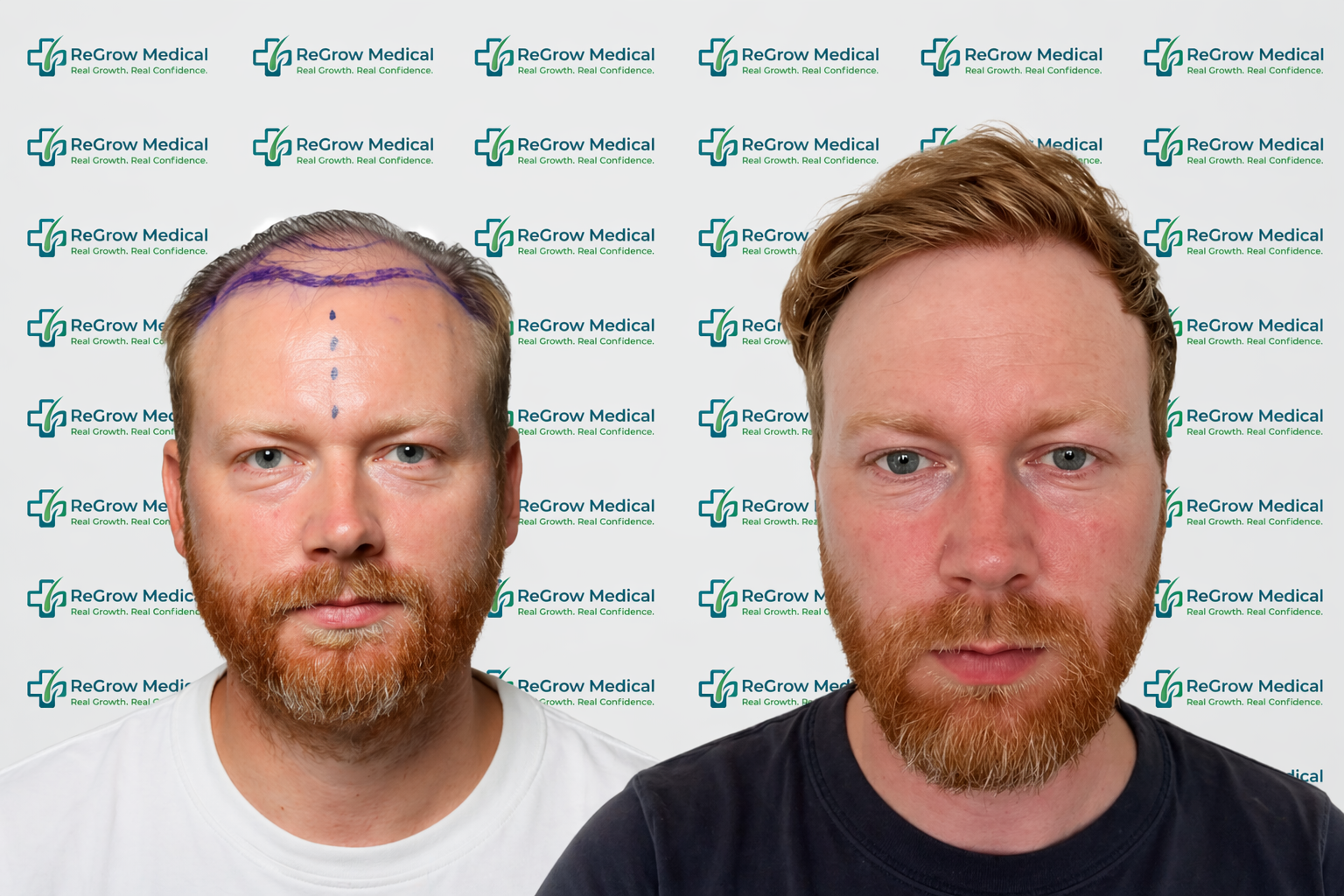
Hairline planning considers height, shape, irregularity, transition, facial proportions, and possible future recession. Mid-scalp work may focus on visual continuity between the front and existing hair. Crown work must follow a changing swirl direction and can use substantial donor resources across a broad surface.
Ask how the proposed design may look from the front, side, and top; how it accounts for continued loss; and what donor reserve remains. Review ReGrow Medical patient results, but compare starting pattern, treatment area, hair characteristics, lighting, angle, hair length, and follow-up timing. Another patient's photograph cannot predict your result.
What Determines Hair Transplant Cost in Bakersfield?
There is no responsible universal price based only on a city, Norwood stage, or photograph. Cost can reflect the size and priority of treatment areas, the graft range and distribution plan, donor complexity, previous procedures or scarring, the planned setting, and the services included before and after surgery.
Ask for a written total after the evaluation. It should explain what is included and what could cause the plan to change. A monthly payment is a financing example rather than the total cost; review the amount financed, term, interest or promotional conditions, fees, eligibility requirements, and total repayment. See ReGrow Medical's current financing information.
Recovery Questions That Matter in Bakersfield
Patients whose routines involve sun, heat, outdoor work, dusty environments, helmets or hard hats, lifting, or strenuous activity should raise those details during planning. Ask how to protect healing donor and recipient areas, which head coverings are allowed at each stage, whether modified duties may be needed, and when your own clinical team says it is appropriate to resume specific activities.
These are questions to discuss, not a universal timeline. Follow the washing, headwear, sun, medication, activity, and follow-up instructions provided for your procedure. Read the general FUE recovery guide, then use your personalized instructions as the controlling plan.
One Year of Postoperative Care
ReGrow Medical provides one year of postoperative care after a hair transplant. Follow-up gives patients a defined place to ask recovery questions, review healing, and discuss developing growth over time. The timing and format of check-ins depend on the patient and procedure.
Before procedure day, confirm how to reach the team, when routine follow-up occurs, and what to do about an unexpected or worsening symptom. Postoperative support helps monitor recovery but cannot guarantee a particular growth rate, density, or cosmetic result.
Medical Leadership and Surgical Roles
Dr. Amiel Moshfegh, M.D., is the founder and medical director of ReGrow Medical. His clinical background includes vascular and interventional radiology and hair restoration, and he provides medical leadership and review for ReGrow Medical's patient education.
Personnel and roles can vary by case, date, and location. Before scheduling, confirm who will examine you, who will design the plan, who will perform extraction, who will create recipient sites, who will place grafts, and who is responsible for postoperative care. Review the California guide to who may perform each hair-transplant step.
Serving Bakersfield and Kern County Communities
The San Dimas Street location serves Bakersfield and can provide a local starting point for people traveling from Kern County communities such as Oildale, Rosedale, Lamont, Arvin, Shafter, Wasco, Delano, Taft, and Tehachapi. Fresno and Visalia are not described as Bakersfield neighborhoods or nearby communities.
If you are traveling from outside metropolitan Bakersfield, confirm the visit type, appointment time, arrival instructions, and whether a driver or overnight plan may be needed for procedure day.
Plan Your Bakersfield Hair Restoration
- Estimate a graft range — Use the interactive scalp map and candidacy questions before an examination.
- Review patient results — Compare starting patterns, treatment areas, angles, lighting, and timing.
- Understand the FUE process — See how donor planning, extraction, recipient sites, and placement fit together.
- Learn what affects cost — Separate an individualized total from an advertised monthly payment.
- Prepare for recovery — Review general healing, shedding, growth, activity, and follow-up stages.
- Verify the clinical team — Know the California rules and ask who performs every surgical step.
Six Questions to Ask Any Hair Transplant Clinic
- What is causing my hair loss, and is it stable enough for surgery?
- Who will examine me and who will perform each surgical step?
- How was my safe donor area defined and protected?
- Why is this graft range appropriate for my priorities?
- What risks, alternatives, and future-loss scenarios should I understand?
- What is included in the written price and postoperative care?
A branded device cannot diagnose hair loss, define a safe donor zone, design an age-appropriate hairline, explain the legal role of each participant, or provide accountable follow-up. Use the California hair-transplant clinic selection guide to compare complete plans rather than machine names or sales claims.
Frequently Asked Questions
Where is ReGrow Medical's Bakersfield location?
The Bakersfield location is at 3941 San Dimas St, Suite 102, Bakersfield, CA 93301. It is in the medical-office area near Bakersfield Memorial Hospital. Use the directions link on this page, and confirm your appointment time and arrival instructions before traveling.
Can I have an in-person hair restoration consultation in Bakersfield?
ReGrow Medical lists Bakersfield as a hair-restoration location. Appointment types, clinical staff, and procedure scheduling can vary, so confirm whether your visit is an in-person examination, a procedure appointment, or a follow-up when you book.
How do I know whether I am a good candidate for FUE?
Candidacy depends on the cause and stability of hair loss, scalp health, usable donor supply, medical history, future-loss risk, and realistic goals. Sudden, painful, inflamed, patchy, scarring, rapidly progressing, or donor-area loss may require further medical evaluation before surgery is considered.
How many hair grafts might I need?
A graft range depends on the size and priority of the treatment zones, existing hair, donor density, hair caliber and curl, scalp contrast, hairline design, and likely future loss. The online calculator offers an educational starting range capped at 3,995 grafts, but an examination is needed to confirm a plan.
Is FUE the same as PRP or scalp micropigmentation?
No. FUE moves follicular units from a donor area to selected recipient areas. PRP is a nonsurgical treatment sometimes considered for certain hair-loss conditions, while scalp micropigmentation creates the appearance of closely cut hair using pigment. They have different purposes and are not interchangeable.
How much does a hair transplant cost in Bakersfield?
There is no responsible universal price for every patient. Cost can depend on the graft range, treatment areas, donor complexity, prior surgery, the planned setting, and what care is included. Ask for a written total after an individualized evaluation and review all financing terms separately.
How should I plan recovery around outdoor or physical work?
Tell the clinical team about heat exposure, dusty environments, hard hats or helmets, lifting, exercise, and the physical demands of your job. They can provide individualized instructions about washing, sun protection, headwear, activity, and when it is appropriate to return to work. General online timelines should not replace those instructions.
How long does ReGrow Medical provide postoperative care?
ReGrow Medical provides one year of postoperative care after a hair transplant. The timing and format of follow-up depend on the patient and procedure. Postoperative support helps monitor recovery, but it does not guarantee a particular growth rate, density, or cosmetic result.
Request a Bakersfield Hair Restoration Visit
Bring a list of medications and previous hair-loss treatments, photographs showing how the pattern has changed, and questions about donor supply, graft priorities, surgical roles, recovery, and long-term planning. Confirm current services, clinical personnel, appointment types, and hours directly with the Bakersfield location.
Request a Bakersfield visit or call (877) 573-4769. Recommendations, candidacy, timelines, and results vary by patient.