How to Choose a Hair Transplant Clinic in California: 12 Questions to Ask
Written by ReGrow Medical Editorial Team.
Medically reviewed by Dr. Amiel Moshfegh, M.D.
Published . Updated .
Direct answer: Start by verifying the responsible physician's active California license and getting an individualized medical evaluation. Ask who will perform each part of FUE, then compare donor planning, documented results, risks, aftercare, and total written cost. Do not choose a clinic based only on a device, social following, discount, or graft estimate.
A hair transplant is elective, but it is still surgery. During follicular unit excision (FUE), follicular units are removed from a donor area and placed into recipient sites in thinning areas. That process involves diagnosis, medical decisions, anesthesia, graft handling, and many small excisions or incisions.
This guide gives California patients a calm, practical way to compare clinics without relying only on advertising or star ratings. Bring the 12 questions below to each consultation and ask for answers specific to your proposed procedure.
This article provides general patient education, not legal advice or an individual medical recommendation. California rules and professional scopes can change. Verify current information with the appropriate licensing authority.
A Quick Hair Transplant Clinic Comparison Checklist
| What to verify | What a clear answer should include |
|---|---|
| Responsible physician | Full legal name, active California license, relevant experience, and role on procedure day |
| Medical evaluation | Likely diagnosis, candidacy, donor assessment, health history, alternatives, and realistic limits |
| FUE team roles | The title, license status, and exact task of each person involved |
| Long-term plan | How the clinic will use and protect finite donor hair if hair loss progresses |
| Patient evidence | Consistent before-and-after photographs from patients reasonably similar to you |
| Safety and aftercare | Anesthesia plan, written instructions, follow-up schedule, and a contact for urgent concerns |
| Complete cost | A written price showing what is included, excluded, refundable, and financed |
Why the Clinic You Choose Matters
The American Academy of Dermatology explains that hair-transplant results depend largely on the surgeon selected and recommends choosing a doctor who understands hair loss and performs hair transplants regularly. A useful consultation should establish why you are losing hair, whether you have enough suitable donor hair, and whether surgery is appropriate now.
California patients can also use public licensing tools. The Medical Board of California license search shows an M.D.'s current license status and may include public enforcement information. Osteopathic physicians are licensed through the Osteopathic Medical Board of California. Licensure is a starting point—not a promise of a particular cosmetic result—so experience, planning, team roles, communication, and follow-up still matter.
12 Questions to Ask a California Hair Transplant Clinic
1. Who is the physician responsible for my care?
Ask for the physician's full legal name and California license number before paying a deposit. Confirm that the name matches the physician who will be responsible for your treatment, then review the complete official license profile.
If a clinic uses the phrase board certified, ask which board issued the certification and verify it through that board's official directory. A state medical license, specialty board certification, professional-society membership, and device-training certificate are different credentials.
2. What is causing my hair loss, and am I a candidate now?
A consultation should involve more than choosing a hairline from a photograph. Ask how the clinician reached the working diagnosis and why surgery is—or is not—appropriate now. The evaluation should consider the pattern and duration of loss, scalp and donor findings, medical and medication history, previous treatment, and the likelihood of future thinning.
Sudden, patchy, painful, inflamed, scarring, rapidly progressing, or medically unexplained hair loss may need further evaluation before cosmetic surgery. Learn more about hair-transplant candidacy.
3. Which physician will be present on procedure day?
The physician featured on a website or consultation call is not automatically the person scheduled for surgery. Ask who will confirm your history, approve the donor and recipient plan, review the hairline, oversee medications and monitoring, respond to a medical concern, and conduct follow-up.
Terms such as doctor-led, physician-supervised, and medical team can mean different things. Ask for names, professional titles, and specific responsibilities.
4. Who performs each step of FUE?
Do not settle for a general answer such as “our experienced team handles it.” Ask the clinic to explain the workflow step by step.
| Procedure stage | Question to ask |
|---|---|
| Diagnosis and candidacy | Who evaluates my hair loss and decides whether surgery is appropriate? |
| Donor and hairline planning | Who determines the harvest area, graft range, and recipient design? |
| Anesthesia and monitoring | Who administers medication, monitors me, and manages a reaction? |
| Donor harvesting | Who operates the punch and makes the follicular-unit excisions? |
| Graft preparation | Who sorts, counts, examines, stores, and hydrates the grafts? |
| Recipient-site creation | Who creates the sites that determine angle, direction, and distribution? |
| Graft placement | Who places the grafts, and what are that person's training and permitted role? |
| Aftercare | Who examines me afterward and handles questions or complications? |
The Medical Board of California's hair-restoration warning states that physicians may not delegate hair-restoration surgery to medical assistants, who are unlicensed and have a limited scope. The International Society of Hair Restoration Surgery likewise urges patients to ask who evaluates them, who participates in surgery, and each person's role, training, experience, and licensure.
Do not rely on the general word technician. Permitted participation can depend on the exact task, professional license, scope of practice, and supervision. A clinic should be able to give you a role-by-role answer in plain language.
For a task-by-task explanation of the state rules behind those questions, read our guide to who can legally perform a hair transplant in California.
5. How much experience do you have with patients like me?
Ask about experience with cases that resemble yours in meaningful ways: hair-loss pattern, donor density, hair caliber and curl, hair-to-scalp contrast, prior surgery, scarring, and the area being restored. A total procedure count does not show whether the clinician regularly treats your type of case.
The clinic should explain what makes your case straightforward or challenging without promising a result before completing the examination.
6. What is my long-term donor plan?
Donor hair is limited. Ask the clinic to show the proposed donor boundaries, how density was evaluated, how extractions would be distributed, how donor thinning would be avoided, and what reserve may remain if native hair loss continues.
A larger graft number is not automatically a better plan. The appropriate range depends on your available donor supply, recipient area, hair characteristics, goals, and likely future loss. Our graft-planning guide explains the variables, but only an individual examination can produce your estimate.
7. How will you design the hairline and recipient sites?
Natural appearance depends on more than graft count. Ask how the proposed hairline accounts for your facial proportions, age, existing hair, donor limitations, and future loss. The clinic should also explain how direction, angle, spacing, and distribution will support a natural transition.
Ask to see the proposed design before surgery and make sure you have time to discuss or decline changes.
8. Why are you recommending this technique or device?
FUE, FUT, robotic systems, motorized punches, implanter pens, and branded devices are tools or approaches—not guarantees of a better outcome. Ask why the proposed method fits your donor area and goals, what reasonable alternatives exist, who controls each instrument, and what limitations the method has.
Compare the main technologies in our guide to ARTAS, NeoGraft, and physician-guided FUE. No machine replaces diagnosis, donor planning, hairline design, or medical judgment.
9. Can I see comparable, well-documented patient results?
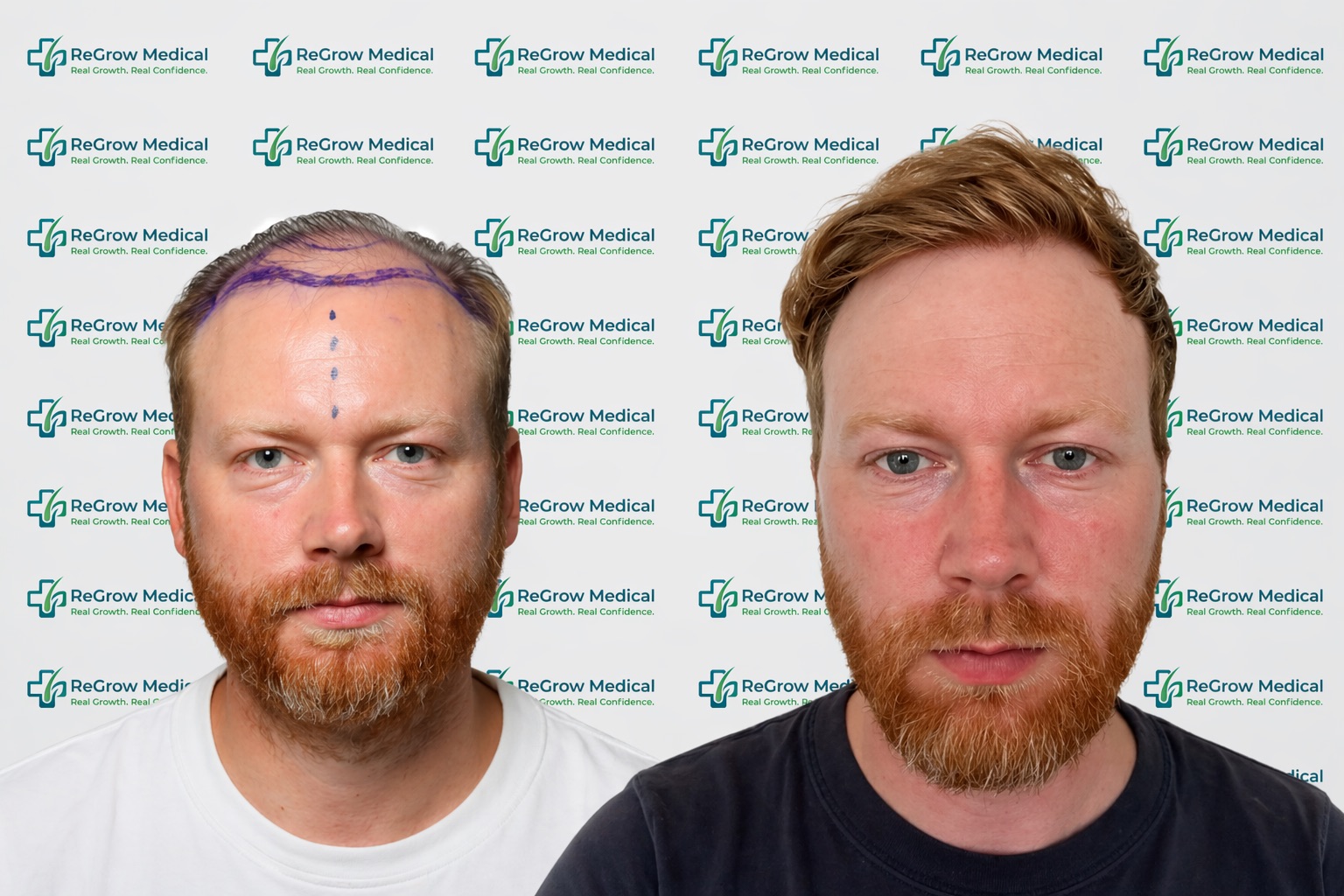
Ask for photographs from patients whose starting pattern, hair texture, donor characteristics, and treatment area are reasonably similar to yours. Confirm the timeline, number of procedures, reported graft count, and whether both images use comparable lighting, angle, hair length, and hair condition.
Results from another patient can demonstrate experience, but they cannot predict your outcome. Review ReGrow Medical patient results and our guide to interpreting FUE before-and-after photographs.
10. What result and recovery timeline is realistic for me?
Ask what improvement is reasonably achievable—not what can be guaranteed. The answer should account for donor supply, hair characteristics, the area being treated, future loss, and whether more than one session could be needed.
Ask what the clinic expects during the first days, at two weeks, around three to four months, at six to nine months, and at a year. Our FUE recovery and growth timeline provides useful background, but individual healing and growth vary.
11. What are the risks, follow-up plan, and urgent-contact process?
Every surgical procedure has risks. The American Society of Plastic Surgeons consultation checklist recommends asking about risks, complications, recovery, how complications are handled, and what options exist if the cosmetic outcome is unsatisfactory.
Before scheduling, ask which risks are most relevant to you, what symptoms require a call, who is available after hours, when follow-up examinations occur, and who evaluates suspected infection, poor healing, unexpected shedding, or a result that does not follow the expected plan. You should receive written preparation and aftercare instructions.
12. Where will surgery occur, what anesthesia is planned, and what is the full cost?
Ask for the exact procedure location, not only the consultation-office address. Also ask what anesthesia is planned and who provides it. California facility requirements can depend on the type and depth of anesthesia, so patients should ask which current rule applies rather than assuming every office has the same requirements.
Request an itemized written quote covering the estimated graft range, clinical and facility services, prescriptions or aftercare items, follow-up visits, deposits, cancellation terms, possible changes in graft count, financing terms, and any revision policy. Compare the total treatment plan—not only a per-graft price or monthly-payment advertisement.
How to Verify a California Hair Transplant Physician
- Request the full legal name and license number. Do not rely only on a first name, clinic brand, or social profile.
- Use the correct official database. Search the Medical Board of California for an M.D. and the Osteopathic Medical Board of California for a D.O.
- Review the complete profile. Check current status, expiration information, and any available public documents.
- Verify claimed board certification separately. Search the official directory of the board the physician names.
- Confirm the procedure location and anesthesia plan. Ask the clinic which licensing, accreditation, or certification requirements apply.
- Ask about discrepancies. A different address or business name may have a reasonable explanation, but the clinic should answer clearly.
Hair Transplant Clinic Red Flags
One concern does not automatically prove that a clinic is unsafe. It is a reason to pause and request a clearer answer.
- The clinic will not identify the responsible physician before taking payment.
- The physician's license cannot be verified through an official state source.
- A salesperson provides the diagnosis or surgical plan without a medical evaluation.
- Answers about donor excisions, recipient-site creation, or graft placement remain vague.
- Unlicensed personnel are described as independently performing surgery.
- A device is marketed as replacing medical judgment.
- The clinic guarantees density, graft survival, “scarless” surgery, or a specific result.
- Before-and-after images use inconsistent lighting, angles, hairstyles, or unclear timelines.
- There is no written aftercare plan or reliable medical contact.
- A limited-time promotion is used to discourage comparison or medical questions.
How to Compare Your Final Two or Three Clinics
After the consultations, compare answers side by side. The strongest choice is usually the clinic that provides the clearest individualized reasoning—not automatically the highest graft estimate, lowest price, or most expensive technology.
| Decision factor | Clinic A | Clinic B | Clinic C |
|---|---|---|---|
| Physician and license verified | |||
| Diagnosis and candidacy explained | |||
| Every surgical role identified | |||
| Long-term donor plan provided | |||
| Comparable results documented | |||
| Risks and alternatives discussed | |||
| Follow-up and urgent-contact plan clear | |||
| Total cost provided in writing |
Frequently Asked Questions
How do I verify a hair transplant doctor's license in California?
Ask for the physician's full legal name and license number. Search an M.D. through the Medical Board of California and a D.O. through the Osteopathic Medical Board of California. Review the full public profile rather than relying on a clinic badge or screenshot.
Can technicians perform an FUE hair transplant in California?
Do not rely on the general word “technician.” Ask for each person's professional title, license status, and exact task. California's Medical Board has warned that hair-restoration surgery cannot be delegated to medical assistants or other unlicensed individuals. A licensed professional's permitted role can depend on the specific task, scope, and supervision.
Does every California hair transplant clinic need facility accreditation?
Not every office procedure performed with local anesthesia must appear in the same outpatient-surgery database. Requirements can depend on the anesthesia level and setting. Ask what anesthesia will be used, where surgery will occur, and which current facility requirement applies.
Is board certification the same as a California medical license?
No. A state medical license and specialty board certification are different credentials. Ask which board issued a claimed certification and verify it through that board's official directory.
What matters more: the FUE machine or the medical team?
A device may assist with parts of FUE, but it cannot replace diagnosis, donor planning, hairline design, medical oversight, or surgical judgment. Ask who operates it and why it is appropriate for your case.
How many consultations should I have before choosing a clinic?
There is no required number. Comparing two or three consultations can be useful when team roles, graft estimates, recommendations, or prices differ. Take enough time to understand the plan and avoid making a decision because of pressure or a temporary promotion.
Compare ReGrow Medical's Six California Locations
ReGrow Medical serves patients from six California locations. Use the same 12 questions at any clinic and choose the location that makes consultation and follow-up practical for you.
- Los AngelesWilshire Boulevard
- Sherman OaksVan Nuys Boulevard
- West HollywoodBeverly Boulevard
- Huntington ParkWalnut Street
- BakersfieldSan Dimas Street
- Orange CountyIrvine - Von Karman Avenue
Convenience should support, not replace, a complete medical evaluation. Confirm the responsible physician, procedure address, team roles, donor plan, follow-up process, and full written cost for the specific location you are considering.
Bring This Checklist to ReGrow Medical
If you are considering FUE in California, bring these questions to your consultation with ReGrow Medical. Ask us to identify the responsible physician and each team member's role, examine your donor supply, and explain how the proposed plan fits your current hair loss and long-term goals.
No online guide can determine candidacy or promise a particular result. A personalized examination is the appropriate next step when you are ready to understand your options.
Request a consultation or explore ReGrow Medical's six Southern California locations. Individual recommendations and results vary.