Hair Restoration in Los Angeles
ReGrow Medical's Los Angeles location provides a local starting point for people considering FUE hair restoration. A useful consultation should do more than name a procedure or produce a graft number from a photograph. It should examine the pattern and history of hair loss, evaluate the donor area, clarify which areas matter most to you, and explain what can be achieved without overusing a limited donor supply.
FUE may be an option for suitable patients with pattern hair loss, a healthy scalp, adequate donor hair, and realistic goals. It is not the right answer for every type of thinning, and no webpage can determine candidacy. Sudden, patchy, painful, inflamed, scarring, rapidly changing, or medically unexplained loss may need medical evaluation before cosmetic surgery is considered.
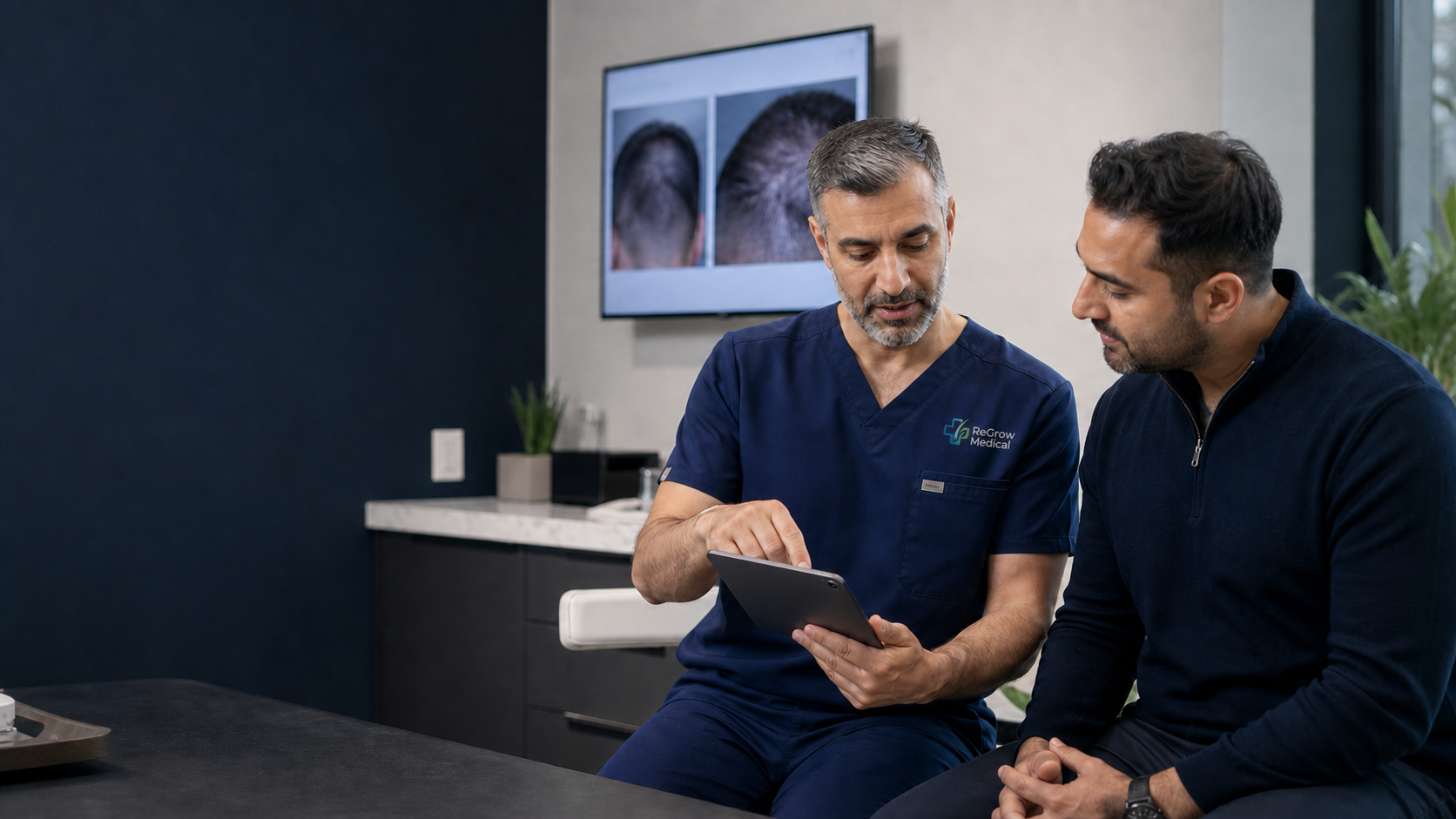
Visit ReGrow Medical on Wilshire Boulevard
ReGrow Medical — Los Angeles5757 Wilshire Blvd, Suite PR2A
Los Angeles, CA 90036
(877) 573-4769
Monday–Friday: 9:00 AM–6:00 PM
Saturday: 10:00 AM–4:00 PM
The Wilshire Boulevard location is in the Miracle Mile area and serves people traveling from Mid-Wilshire, Hancock Park, Hollywood, Koreatown, Beverly Hills, West Hollywood, Culver City, and other parts of greater Los Angeles. Confirm appointment and arrival details directly with the team when scheduling.
Get directions to the Los Angeles location.
What Hair Restoration Means
Hair restoration is broader than hair-transplant surgery. The first question is what is causing the loss and whether it is stable enough to plan around. The next questions concern the recipient area—the hairline, frontal scalp, mid-scalp, crown, or a combination—and the donor follicles that may be moved safely. Medical treatment, observation, referral for further evaluation, or a staged surgical plan may be more appropriate than trying to address every area at once.
A transplant redistributes existing follicles; it does not create an unlimited new supply. That is why long-term planning matters. A responsible plan considers how native hair may change, how much donor reserve should remain, and which treatment areas will make the most useful visual difference. Learn more about hair-transplant candidacy and use the educational graft calculator to organize questions before your consultation.
How FUE Hair Transplantation Works
Follicular unit excision, commonly called FUE, removes naturally occurring follicular units individually from a suitable donor area. Those grafts are prepared and placed into planned recipient sites. FUE avoids the long linear donor incision associated with strip harvesting, but it is still surgery and leaves small extraction sites. Healing, visibility, growth, and the final cosmetic effect vary from person to person.
Natural-looking work depends on more than the extraction method. Diagnosis, donor boundaries, graft distribution, hairline design, recipient-site angle and direction, handling of the grafts, and follow-up all influence the plan. Before scheduling, ask who is responsible for your care and who performs each surgical step. ReGrow Medical's California guide explains how to verify the people and roles involved in a hair transplant.
Women's, Eyebrow, and Beard Hair Restoration in Los Angeles
ReGrow Medical offers FUE hair transplantation for women as well as eyebrow and beard restoration for appropriate candidates. Each plan requires its own diagnosis, design, graft-selection, and placement strategy.
Hair Transplant for Women
Women may be candidates for FUE when the cause and pattern of hair loss are understood and the donor region is stable and suitable. Planning may address a widening part, selected hairline or temple recession, or certain stable traction-related patterns. Diffuse thinning, especially in the donor area, can make transplantation unsuitable. Learn about hair restoration for women.
Eyebrow Transplant
FUE eyebrow transplantation moves carefully selected donor follicles into areas of sparse or missing brow hair. Planning focuses on brow shape and the shallow angle and direction of each graft. Because donor hairs usually come from the scalp, ongoing trimming and grooming may be needed. Learn about eyebrow transplantation.
Beard Transplant
FUE beard transplantation can add follicles to selected areas of the cheeks, jawline, chin, mustache, or sideburns. The plan considers existing facial-hair growth, facial proportions, placement direction, coverage goals, and available donor supply. Learn about beard transplantation.
Candidate note: Hair loss affecting the scalp, eyebrows, or beard may have hereditary, medical, inflammatory, scarring, or traction-related causes. The cause and stability of loss, condition of the skin or scalp, donor supply, and treatment goals should be evaluated before surgery is recommended.
What Happens at Your First Hair Restoration Visit?
- Your history and goals are reviewed. Be ready to discuss when the loss started, how it has changed, previous treatment, relevant health history, medications, prior scalp procedures, and the areas you want to improve.
- The pattern and scalp are assessed. The evaluation should consider whether the presentation looks consistent with a transplantable pattern or whether additional medical evaluation is appropriate.
- The donor area is examined. Density, hair caliber, curl, contrast, miniaturization, previous harvesting, and the size of the safe donor zone affect what may be possible.
- Priorities are discussed. Restoring a frontal frame, adding coverage through the mid-scalp, and working in the crown use donor hair differently. A plan should explain those tradeoffs.
- Next steps are explained. If surgery appears appropriate, the team can discuss a preliminary graft range, procedure approach, recovery, risks, follow-up, and individualized cost. The final plan may change after a complete examination.
Get a Preliminary Graft Range and FUE Candidacy Screen
ReGrow Medical's three-minute educational simulator can help you prepare for a Los Angeles consultation. Select the areas you want to address, describe your hair-loss pattern and progression, share your impression of the donor area, and upload one or more clear front, top, or crown photos. The simulator provides a preliminary graft range and a basic FUE candidacy screen; its online estimate is capped at 3,995 grafts.
Estimate your preliminary graft range or request a Los Angeles consultation.
Important: Uploaded photos are not automatically diagnosed by AI. The estimate is educational and is not a diagnosis, treatment recommendation, or surgical plan. A clinical examination is required to assess scalp health, measure donor density, confirm candidacy, and determine an individualized graft plan.
Hairline, Mid-Scalp, and Crown Planning
The same graft count can produce different visual effects depending on where and how the grafts are distributed. Hairline work often emphasizes a natural transition, age-appropriate placement, and single-hair grafts near the leading edge. Mid-scalp work may focus on connecting the frontal area to existing hair. Crown restoration must account for a broader surface and a changing swirl direction, and it can consume a substantial portion of a finite donor supply.
A larger number is not automatically a better plan. Ask why a particular range is being proposed, which area receives priority, how donor density was evaluated, and what reserve may remain if native thinning continues. For a focused explanation, read hairline versus crown transplant planning and how graft needs are estimated.
Where PRP May Fit Into Hair-Loss Care
Platelet-rich plasma, or PRP, is prepared from a patient's blood and injected into the scalp. Research suggests it may support hair density in some patients with androgenetic alopecia, but preparation methods, schedules, evidence quality, and individual responses vary.
PRP and FUE do different jobs
PRP does not replace a proper diagnosis and should not be presented as a way to recreate follicles in a completely bald area. Its role differs from FUE, which redistributes existing donor follicles.
Please confirm first: Contact ReGrow Medical directly to ask whether PRP is currently available at the Los Angeles location and whether it may be appropriate for you.
What Determines Hair Transplant Cost in Los Angeles?
There is no responsible universal price for every patient. Cost can change with the graft range, the number and size of treatment zones, case complexity, prior surgery, the planned procedure setting, and the services included before and after surgery. A low advertised monthly payment is not the same as the total cost, and a per-graft price does not explain the quality or scope of the plan.
Request a written estimate after the evaluation. It should identify what is included, whether the graft range can change, which follow-up services are part of the plan, and the complete terms of any financing option. Compare the clinical reasoning and total plan—not only the headline number. The separate Los Angeles hair-transplant cost guide explains the questions to ask without substituting for a personal quote.
Recovery, Growth, and One Year of Postoperative Care
FUE recovery is a process rather than one date. Temporary redness, tenderness, swelling, crusting, and shedding can occur early. Transplanted hairs commonly shed before new growth becomes visible, and maturation continues over the following months. Individual healing and growth vary, so another patient's timeline should not be treated as a promise.
ReGrow Medical provides one year of postoperative care after a hair transplant. Your plan should explain how to wash and protect the treated areas, which activities or products to avoid, when follow-up occurs, and whom to contact about an unexpected symptom. Read the FUE recovery guide for general education, then follow the instructions given specifically to you.
How to Choose a Hair Transplant Clinic in Los Angeles
Location is useful because consultations and follow-up are easier when the clinic is accessible, but convenience should not replace due diligence. Verify the responsible physician and current license. Ask for the title, license, training, and exact role of every participant. Confirm where the procedure will take place, how candidacy and donor limits were determined, what risks and alternatives apply, and how questions or complications are handled afterward.
Review before-and-after photographs carefully. Look for patients with a reasonably comparable starting pattern and hair characteristics, and compare lighting, angle, hair length, and timing. Photographs can demonstrate experience, but they cannot predict your result. See ReGrow Medical patient results and the California clinic-selection checklist before deciding.
Plan Your Los Angeles Hair Restoration
Choose the question that matches where you are in the decision process. These focused resources explain graft planning, patient results, FUE, cost, recovery, and the roles people may perform during hair-transplant surgery.
- Estimate my graft range — Get an educational starting range before an in-person examination.
- See real patient results — Browse ReGrow Medical's before-and-after gallery.
- Understand physician-guided FUE — Learn how donor planning, extraction, and placement fit together.
- Review Los Angeles cost factors — Understand what can shape an individualized estimate.
- Follow the recovery timeline — Review general healing, shedding, growth, and follow-up stages.
- Verify who may perform each surgical step — Review California rules and questions to ask any clinic.
How ARTAS and NeoGraft Compare With Physician-Guided FUE
ARTAS and NeoGraft are branded technologies used during parts of some FUE workflows. They do not determine candidacy or replace diagnosis, donor planning, hairline design, medical judgment, or an experienced team.
Whatever equipment a clinic uses, ask who evaluates you, who performs each surgical step, and why the proposed approach fits your donor area and goals. Read our ARTAS, NeoGraft, and physician-guided FUE comparison for more detail. Mentioning these technologies here does not mean they are offered at this location; confirm available options during your consultation.
Frequently Asked Questions
Where is the ReGrow Medical Los Angeles location?
ReGrow Medical's Los Angeles location is at 5757 Wilshire Blvd, Suite PR2A, Los Angeles, CA 90036. Use the map and directions link on this page to plan your visit, and confirm appointment details when scheduling.
What happens at a hair restoration consultation?
A consultation should review your hair-loss history, goals, scalp, recipient areas, and donor area. The team can explain whether further medical evaluation is appropriate, discuss realistic restoration priorities, and outline possible next steps. A photograph or online estimate cannot replace an individual examination.
How do I know whether I am a good candidate for FUE?
FUE candidacy depends on the cause and stability of your hair loss, the quality and quantity of donor hair, scalp health, medical history, future-loss risk, and realistic expectations. Sudden, patchy, painful, inflamed, scarring, or unexplained loss may need medical evaluation before cosmetic surgery is considered.
How many hair grafts might I need?
The appropriate graft range depends on the size and priority of the areas being restored, surviving native hair, donor density, hair caliber and curl, hair-to-scalp contrast, hairline design, and likely future loss. ReGrow Medical's graft calculator can provide an educational starting range, but the plan must be confirmed through an examination.
How much does a hair transplant cost in Los Angeles?
Cost varies with the recommended graft range, treatment areas, complexity, procedure plan, and what the clinic includes in follow-up care. Request an individualized written quote that explains what is included, any financing terms, and whether the plan could change after the in-person examination.
Does ReGrow Medical offer hair transplants for women, eyebrows, and beards in Los Angeles?
Yes. ReGrow Medical offers FUE hair transplantation for women and FUE eyebrow and beard transplantation for appropriate candidates. Women's candidacy depends on the cause and pattern of loss and whether donor hair is stable. Eyebrow and beard plans also require individualized design, direction, coverage, and donor-supply decisions.
How does FUE compare with ARTAS or NeoGraft?
ARTAS and NeoGraft are branded technologies used in parts of the FUE workflow; they do not replace diagnosis, donor planning, hairline design, medical judgment, or an experienced team. Ask who controls each device or instrument, who performs each surgical step, and why the proposed approach fits your donor area and goals.
What should I expect after an FUE hair transplant?
Early healing can include temporary redness, tenderness, swelling, crusting, and shedding of transplanted hairs. New growth develops gradually over the following months, and the timeline varies by patient. Follow the individualized washing, activity, medication, and follow-up instructions provided by your clinical team.
How long does ReGrow Medical provide postoperative care?
ReGrow Medical provides one year of postoperative care after a hair transplant. Your individual follow-up schedule and instructions should be confirmed with the clinical team, and unexpected symptoms or urgent concerns should be reported promptly rather than waiting for a routine check-in.
Plan Your Los Angeles Hair Restoration Consultation
Bring a list of your medications and previous hair-loss treatments, photographs showing how the pattern has changed, and questions about donor supply, graft priorities, team roles, recovery, and long-term planning. The goal of the first visit is not to pressure you into a procedure. It is to determine whether FUE is appropriate and to explain a plan you can evaluate clearly.
Request a hair restoration consultation or call (877) 573-4769. Recommendations, candidacy, timelines, and results vary by patient.