Hair Transplant for Women: What's Different and Who Qualifies
Written by ReGrow Medical Editorial Team.
Medically reviewed by Dr. Amiel Moshfegh, M.D.
Published . Updated .
Hair loss is often framed as a men's issue — but the reality is that roughly 40% of hair loss sufferers in the United States are women. Female hair loss is just as real, just as distressing, and just as treatable as male pattern baldness. Yet women are frequently told by clinics that they're "not good candidates" for a hair transplant, often without a thorough evaluation. The truth is more nuanced — and more hopeful — than that.
At ReGrow Medical, we have extensive experience treating female hair loss with FUE hair transplant surgery. This guide explains how women's hair loss differs from men's, who makes a good candidate for a women's hair transplant, what the procedure involves, and what realistic results look like.
How Female Hair Loss Differs from Male Pattern Baldness
Male pattern baldness (androgenetic alopecia in men) typically follows a predictable path: a receding hairline, thinning crown, and eventual baldness in a defined pattern described by the Norwood scale. The donor area at the back and sides of the scalp remains largely unaffected, which is what makes hair transplants so effective for men.
Learn more about the causes of hair loss in women and when a transplant is the right solution.
Female hair loss is different in two important ways. First, the pattern is different: women with female pattern hair loss (FPHL) typically experience diffuse thinning across the top of the scalp rather than a clearly receding hairline. The frontal hairline is often preserved, but the part widens and the overall density decreases. Second — and this is the key clinical challenge — the donor area may also be affected. In women with diffuse thinning, the hair at the back and sides of the scalp can be just as thin as the hair on top, which limits the supply of healthy grafts available for transplantation.
This is why the candidacy evaluation for a women's hair transplant is more complex than for men — and why it requires an experienced surgeon who understands the nuances of female hair loss patterns.
Who Is a Good Candidate for a Women's Hair Transplant?
Not every woman with hair loss is a good candidate for a hair transplant — but many are, and the evaluation requires looking at several specific factors:
Our FUE technique is particularly well-suited for women because it leaves no linear scar.
Stable Donor Area
The most important factor is whether the donor area (the back and sides of the scalp) has sufficient density of healthy, DHT-resistant follicles. Women who have diffuse thinning throughout the entire scalp — including the donor zone — may not have enough healthy grafts to produce meaningful results. Women whose thinning is concentrated at the top and front of the scalp, with a healthy donor area, are typically excellent candidates.
Defined Hair Loss Pattern
Women with a clearly defined area of hair loss — such as a receding hairline, widening part, or thinning frontal zone — tend to get the most predictable and dramatic results. Diffuse, unpatterned hair loss throughout the entire scalp is more challenging to treat surgically.
Cause of Hair Loss
Hair transplants work best for hair loss caused by androgenetic alopecia (female pattern hair loss). Other causes — such as alopecia areata, telogen effluvium (temporary shedding from stress or nutritional deficiency), or hormonal imbalances — may not respond to transplantation, or may require the underlying condition to be addressed first. A thorough consultation will help identify the root cause of your hair loss before any surgical recommendation is made.
Age and Hair Loss Stability
Like male patients, women benefit from having a hair loss pattern that has stabilized before undergoing transplantation. If hair loss is still actively progressing, transplanted grafts may look out of place as surrounding natural hair continues to thin. Your surgeon will assess whether your hair loss has reached a stable point and may recommend medical management (such as minoxidil) to stabilize it before surgery.
Realistic Expectations
A hair transplant can dramatically improve density and restore a natural hairline — but it works with the hair you have, not the hair you had at 20. The goal is meaningful, natural improvement: a fuller appearance, a restored hairline, and renewed confidence. Patients who understand this tend to be the most satisfied with their results.
What Does a Women's Hair Transplant Procedure Involve?
The procedure itself is the same FUE technique used for male patients — individual follicular units are extracted from the donor area and implanted into the thinning zones — but the planning and execution are tailored specifically to female anatomy and hair loss patterns.
See real female patient results in our before and after gallery.
One important difference: many women choose to have their procedure performed without shaving the entire donor area. At ReGrow Medical, we offer a no-shave or minimal-shave FUE option for female patients, where only a small section of the donor area is trimmed while the surrounding hair covers the extraction site. This allows patients to return to their normal appearance much more quickly — often within days.
The procedure is performed under local anesthesia and typically takes between four and eight hours depending on the number of grafts. Most patients experience mild discomfort rather than significant pain, and many listen to music or watch a show during the session. There is no general anesthesia, no hospital stay, and no stitches.
What Does Recovery Look Like for Women?
Recovery after a women's FUE hair transplant follows the same general timeline as male patients, with a few practical differences. Because many female patients opt for the no-shave technique, the recovery is often more discreet — the small scabs around the implanted grafts are easier to conceal with existing hair length.
In the first two to four weeks, patients typically experience the shock loss phase, where the transplanted hairs shed temporarily before the follicles enter a new growth cycle. This is completely normal and expected. New growth typically begins to emerge around months three to four, with significant density improvement visible by months six to eight. Full results are generally achieved at the 12-month mark.
Most women are able to return to work within three to five days of their procedure and can resume normal activities — including exercise and hair washing — within two weeks.
What Results Can Women Expect?
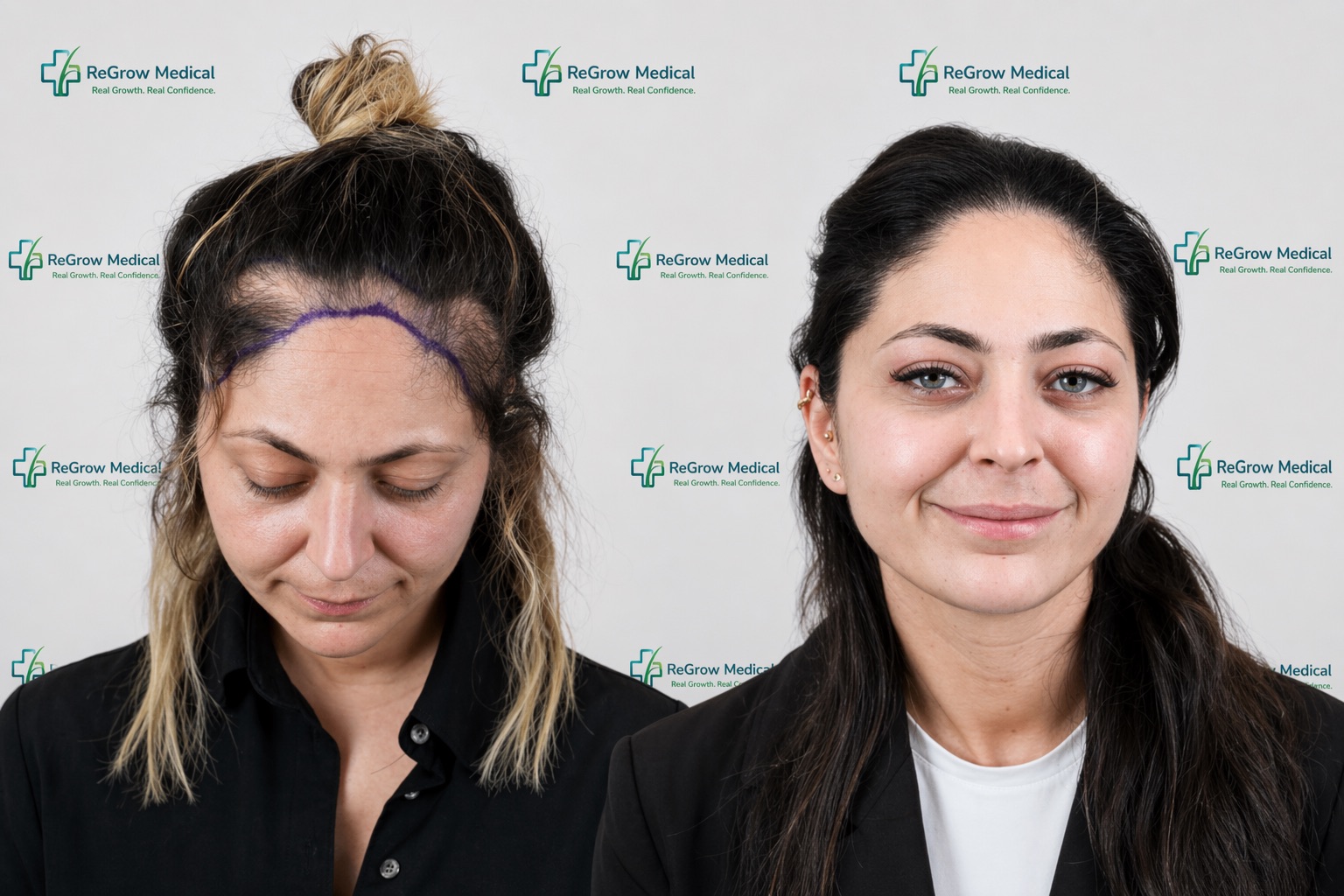
The before-and-after photo at the top of this article shows a real ReGrow Medical patient who came to us with significant frontal thinning and a compromised hairline. After a thorough consultation and a personalized FUE procedure, her hairline was fully restored and her frontal density dramatically improved — results she described as life-changing.
For women with well-defined hair loss patterns and healthy donor areas, FUE hair transplant results are often among the most dramatic and satisfying of any cosmetic procedure. The transplanted hair grows naturally, can be styled and colored like normal hair, and is permanent — because the follicles are taken from areas genetically resistant to the hormones that cause hair loss.
Are There Non-Surgical Alternatives?
For women who are not yet candidates for surgery — or who want to maximize their results — non-surgical options can play an important role. Minoxidil (Rogaine) is FDA-approved for female pattern hair loss and can slow progression and stimulate some regrowth in early-stage cases. PRP (platelet-rich plasma) therapy is another option that uses growth factors from your own blood to stimulate dormant follicles. These treatments work best as complements to surgery, not replacements for it in patients with significant hair loss.
At ReGrow Medical, we take a comprehensive approach: we'll evaluate your hair loss, discuss all available options — surgical and non-surgical — and recommend the path that gives you the best long-term outcome for your specific situation.
Why Choose ReGrow Medical for Women's Hair Restoration?
Female hair loss requires a different level of expertise, sensitivity, and surgical precision than male hair restoration. At ReGrow Medical, we have treated hundreds of female patients across our six Southern California locations, and we understand the unique physical and emotional dimensions of women's hair loss.
Our consultations are thorough, honest, and completely free. We will assess your scalp, evaluate your donor area, identify the cause of your hair loss, and give you a clear picture of whether you are a surgical candidate — and if so, what results you can realistically expect. There is no pressure, no sales pitch, and no obligation.
If you are a woman experiencing hair loss and wondering whether a hair transplant might be right for you, the best first step is a conversation with our team. Book your free consultation today at any of our six Southern California locations — and take the first step toward hair you feel confident in again.
Frequently Asked Questions About Hair Transplants for Women
Do hair transplants work differently for women?
The FUE technique is the same, but women's hair loss patterns differ from men's. Women typically experience diffuse thinning rather than complete baldness, so the surgical approach focuses on adding density throughout rather than rebuilding a hairline.
Will I need to shave my head for a hair transplant?
No. At ReGrow Medical, we offer "no-shave" FUE options for women where only a small donor area is trimmed and concealed by surrounding hair. You can return to work without anyone knowing you had a procedure.
How many grafts do women typically need?
Women typically need 1,500–3,000 grafts depending on the area and degree of thinning. Hairline refinement may require only 800–1,200 grafts, while broader density restoration needs 2,000–3,000+.
Ready to explore your options? Book a free consultation at our Los Angeles clinic.
Medical References
Sources last reviewed .
- Hair Transplantation — NCBI Bookshelf (StatPearls)
- Hair Transplant Practice Guidelines — Journal of Cutaneous and Aesthetic Surgery (PubMed Central)
- A hair transplant can give you permanent, natural-looking results — American Academy of Dermatology
- Follicular Unit Extraction Hair Transplant — Journal of Cutaneous and Aesthetic Surgery (PubMed Central)
- Types of hair loss — American Academy of Dermatology
This article is for general education and is not a substitute for an individualized diagnosis or treatment plan. Results and candidacy vary.